QUANTUM INDEX REPORT
7. Education
Global quantum technology education is experiencing rapid expansion across all educational levels, with significant developments in K-12 programs and higher education. At the primary and secondary level, initiatives such as the National Q-12 Education Partnership in the US, industry partnerships in China, and the EU’s Quantum Flagship project are introducing quantum concepts to younger students.
In higher education, Germany leads globally with master programs with “quantum” in the degree name, followed by the UK and the US. These three nations represent 45% of all quantum master’s programs worldwide.
Bachelor degree enrollment trends in the US for QIST related disciplines shows strong growth especially in related topics such as Computer Science while Electrical Engineering and Physics enrollments remained stable. Some commentators suggest the field faces significant workforce challenges in the future, highlighting the need for expanded domestic talent pipelines while maintaining international recruitment capabilities.
The creation of a mature quantum ecosystem depends not only on scientific breakthroughs and unlocking commercial use cases but also on the cultivation of a multidisciplinary workforce equipped to build, navigate, and govern this emergent space. However, the inherently complex nature of quantum phenomena and the reliance on advanced mathematics and physics concepts can pose a perceived barrier to education and training. Despite this there are an increasing range of global initiatives focused on providing training at all levels, from K-12, to postgraduate and professional development.
In the US, the National Q-12 Education Partnership[1] was launched in 2020 as part of the national quantum strategy and aims to increase the capabilities and number of students who are ready to engage in the quantum workforce by developing K-12 level educational materials and providing classroom tools for hands-on experiences.
There are similar examples of quantum education programs targeted at this level in China[2], and in the EU, through its Quantum Flagship’s dedicated initiative to implement quantum topics in high school curricula[3]. Industry also showed an interest in filling the formal curricula lag in quantum for high school students. The The Coding School, a non-profit, launched an introductory course in quantum technologies targeted at high school students in collaboration with IBM, MIT and UC Berkeley in 2020.[4] The Coding School reports that their Introduction to Quantum Computing course was attended by over 18000 high school students so far, and it is continued to be offered in collaboration with Google Quantum AI for its September 2025 iteration.[5]
Many universities internationally offer specialized degrees in quantum technologies, at both undergraduate and graduate level. These programs often involve interdisciplinary approaches, combining physics, computer science, and engineering to prepare students for careers in quantum research and development.
In this chapter, we present global data on master’s degrees dedicated to quantum technologies. Given the very limited number of offerings of bachelor’s degrees dedicated to quantum technologies, we present enrollment data for bachelor’s degrees in the physics, computer science, and engineering fields within the US.
7.1. Postgraduate Education
The distribution of programmes suggests that quantum technology is becoming increasingly important globally, with major research hubs like Germany, UK, and the US leading the way.
As the quantum technology industry continues to grow, there may be increasing demand for specialized master’s degrees tailored to different sectors. Some institutions have already begun offering dedicated streams within their programs. This trend towards more specialized training reflects the growing diversity of roles in the quantum sector and the need for education to keep pace with industry demands.
Germany is the leading nation in terms of master’s degrees in quantum technologies, with 12 programs on offer. The UK follows closely with 10 programs, whereas the United States offers 9. France and the Netherlands are also in the top 5 countries offering master’s degrees specifically referring to “quantum” in the degree title.
The number of programs also reflects the interdisciplinary nature of quantum technology, which often involves physics, engineering, computer science, and mathematics. This diversity of possible departmental homes within universities is likely contributing to the growth of these programs. As expectations for commercial application breakthroughs in quantum computing continue to rise, we expect to see further expansion in the number of master’s programs dedicated to this field globally.
Overview of Master Degrees
Master degrees with a specific reference to "quantum" in the degree name
Overview of Quantum Degrees
Degrees with a specific reference to “quantum” in the degree name
Based on Studyportals data, there are 69 master’s degrees distributed across 19 countries with a specific reference to “quantum” in the degree name. Germany stands out as the leader, offering 12 quantum-related master’s programs, which accounts for 17.4% of the global total. The United Kingdom follows closely behind with 10 programs (14.5%), while the United States offers 9 programs (13.0%). France and the Netherlands each contribute 6 programs (8.7% each), completing the top five countries.
The distribution pattern reveals strong concentration in European countries and the United States, with Germany, the UK, and US together accounting for 45% of all quantum master’s programs. There is a notable gap between the leading group and the majority of countries, with most offering just a single program. In this list, the Asia-Pacific region shows relatively limited representation, with only Japan, Malaysia, and Australia offering programs, each contributing a single quantum-related master’s degree to the total count.
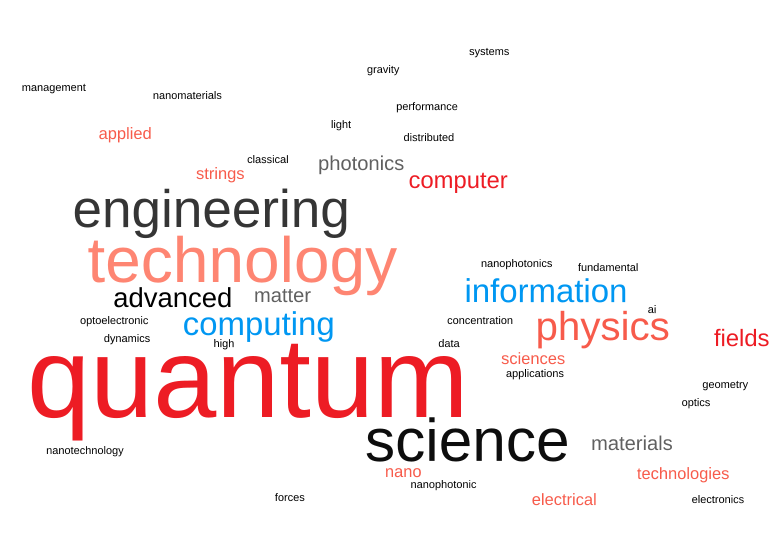
The QED-C State of the Global Quantum Industry Report[6] presented a Word Cloud of their quantum postgraduate degrees database. The Word Cloud representing the data used in our report resulted in the following:
Undergraduate degree enrollments in the US
2019-2024
7.2. Enrollment numbers
The 2021 US Report[7] “The Role of International Talent in Quantum Information Science” focuses on the future workforce needs of Quantum Information Science and Technology (QIST). The report concludes that the quantum science and technology sector faces a critical talent shortage across all major sectors, including industry, academia, and government. While the National Quantum Initiative aims to develop new workforce talent, there’s an immediate need for skilled professionals, and uncertainty remains about whether existing programs will sufficiently meet future demands. According to the report, international talent plays a crucial role, with foreign students comprising approximately half of U.S. graduates in quantum-related fields.
The United States has historically benefited from retaining these international scholars, with about 70% of foreign STEM PhD graduates choosing to stay in the country as of 2017. However, developing new quantum expertise is a lengthy process requiring roughly a decade of post-secondary education and training. To address the growing workforce demands, the United States will need to pursue a dual strategy: expanding its domestic talent pipeline while maintaining its ability to attract and retain international expertise.
The report states that “the most QIST-relevant degree fields are physics, electrical engineering, and computer science” and explains that these domains were selected based on two criteria: preliminary search of keywords for online job postings and, analysis of doctoral thesis titles, abstracts, and keywords.
To better understand emerging enrollment trends for physics, electrical engineering, and computer science courses, we analyzed data from the NSC Research Center (January 2025 update).
Based on the enrollment data from 2019 to 2024, Computer Science exhibits the highest student numbers and substantial growth over the period. The Electrical, Electronics, and Communications Engineering program maintains moderate enrollment levels, whereas Physics enrollments show the smallest but most consistent enrollment pattern, with a narrower range of 4,811 students between its lowest and highest enrollment figures.
The data categorization involved challenges as the major field groups at times had interconnected degrees such as “Computer and Information Science, general”, “Astronomy and Astrophysics” which are not included in the subject-level enrollment data. In order to provide a fuller picture, the report also presents the enrollment numbers for the three major field families Engineering, Physical Sciences, and Computer and Information Sciences and Support Services.
Undergraduate major field family enrollments in the US
2019-2024
7.3. Future Research
The quantum education landscape is rapidly evolving, but it remains fragmented and under-documented. While anecdotal evidence points to rising interest and enrollment in quantum-related programs, there is a critical need for data on student demographics, institutional investment levels, and career outcomes. Such data is essential for identifying best practices, highlighting gaps in access and equity, and supporting evidence-based policymaking.
We invite contributions from the quantum education community to future editions of this report. The objective is to deepen and expand the insights provided.
Researchers and educators interested in sharing enrollment data, curriculum insights or information about new programs are encouraged to contact us. We hope that our community-led approach will facilitate a comprehensive global overview of quantum education initiatives and facilitate the development of more effective educational strategies for the field.
You can reach us at contact@qir.mit.edu
How to cite this work:
Ruane, J., Kiesow, E., Galatsanos, J., Dukatz, C., Blomquist, E., Shukla, P., “The Quantum Index Report 2025”, MIT Initiative on the Digital Economy, Massachusetts Institute of Technology, Cambridge, MA, May 2025.
The Quantum Index Report 2025 by Massachusetts Institute of Technology is licensed under CC BY-ND 4.0 Attribution-NoDerivatives 4.0 International.
Methodology
Education:
The education data represented in the “ Postgraduate Education” section was collected from the StudyPortals resource and presents the master degrees that make a specific reference to “quantum” in the degree name found in the named resource.
Education Enrollment data was collected from the publicly available data set “Current Term Enrollment Estimates” with the January 2025 updates of the NSC Research Center. The NSC states in their methodology for compiling the relevant dataset that the data is based on administrative data directly derived from college and university registrars. NSC declares that since the fall of 2021, “institutions actively submitting enrollment data to the Clearinghouse account for 97 percent of all enrollments at Title IV, degree-granting institutions in the U.S.”.
The 2021 US Report “The Role of International Talent in Quantum Information Science” states that “the most QIST-relevant degree fields are physics, electrical engineering, and computer science” and explains that these domains were selected based on two criteria: preliminary search of keywords for online job postings and, analysis of doctoral thesis titles, abstracts, and keywords. Therefore we retrieved the student enrollment data for the relevant three degrees.
We used ‘Electrical, Electronics, and Communications Engineering’ (141000 – Major Field Group CIP) enrollment data as a subcategory of Engineering, Physics degree (400800 – Major Field Group CIP) enrollment data as a subcategory of Physical Sciences, Computer Science degree (110700 – Major Field Group CIP) enrollment data as a subcategory of Computer and Information Sciences and Support Services. The data categorization had challenges as the major field groups at times had interconnected degrees such as “Computer and Information Science, general”, “Astronomy and Astrophysics” which are not included in the subject-level enrollment data. In order to provide a fuller picture, the report also presents the enrollment numbers for the three major field families Engineering, Physical Sciences, and Computer and Information Sciences and Support Services.
References
References
[1] National Quantum Initiative, ‘Enabling People’ (National Quantum Initiative) <https://www.quantum.gov/workforce/> accessed 24 March 2025.
[2] SpinQ Press Release, ‘Shenzhen Middle School:Building a Quantum Computing Elective Program from the Ground Up’ (28 June 2024) <https://www.spinquanta.com/news-detail/shenzhen-middle-school-building-a-quantum-computing-elective-program-from20250121075716> accessed 24 March 2025.
[3] ‘QTEdu- Coordination and Support Action for Quantum Technology Education’ (Quantum Flagship) <https://qt.eu/projects/archive/csa-projects/qtedu> accessed 24 March 2025.
[4] ‘IBM and Qubit by Qubit Offer Quantum Course | IBM Quantum Computing Blog’ <https://www.ibm.com/quantum/blog/year-three-quantum-coding-school> accessed 28 March 2025.
[5] ‘QubitxQubit | Course Info’ <https://www.qubitbyqubit.org/course-info> accessed 28 March 2025.
[6] QED-C, ‘State of the Global Quantum Industry Report’ (2025) <https://quantumconsortium.org/stateofthequantumindustry2025/> accessed 24 March 2025.
[7] Subcommittee on Economic and Security Implications of Quantum Science Committee on Homeland and National Security of the National Science & Technology Council, ‘The Role of International Talent in Quantum Information Science’.
Featured Degrees in Quantum
*Reach out to us to be featured in this section
contact@qir.mit.edu

Immersive Experience in a Revolutionary Field
Trinity College Dublin offers a groundbreaking Master of Science degree in Quantum Science and Technology, preparing students for careers at the forefront of one of the most exciting fields in modern science and engineering. This 1-year full-time program focuses on the theoretical and software aspects of quantum technology, blending quantum information science, physics of quantum hardware, and quantum materials. Students will gain hands-on experience writing programs for quantum computers and connect with like-minded peers passionate about pursuing further studies in this rapidly evolving field.
Cutting-Edge Curriculum and Industry Connections
The MSc curriculum is designed to equip students with foundational knowledge across six core modules, including Introduction to Quantum Information Science, Open Quantum Systems, and Physical Implementations of Quantum Technology. What sets this program apart is its industry connections - lecturers from multinational companies, startups, and research institutions share insights throughout the year, providing students with real-world perspectives on the challenges facing the quantum industry today. A tailored internship or project in industry or academia completes the program, ensuring graduates are ready to contribute to and advance the quantum revolution. With Trinity's renowned School of Physics as its foundation, this degree offers unparalleled access to cutting-edge quantum research excellence.

Hands-on Training for Emerging Technologies
The University of Oregon offers a unique Master's program in Applied Physics with a focus on Quantum & Nanotechnology, providing students with cutting-edge skills in experimental techniques crucial for the rapidly growing quantum industry and adjacent nanotechnology sectors. This innovative program goes beyond traditional master's degrees by emphasizing hands-on training through focused coursework, labs, and a nine-month paid internship. Students gain expertise in state-of-the-art facilities including nanofabrication, microwave measurement equipment, cryogenic systems, and advanced optics setups. By combining theoretical knowledge with practical experience, this program prepares graduates to excel in launching careers working in industrial research laboratories across various emerging technologies.
Industry-Ready Education with Real-World Experience
What sets this University of Oregon program apart is its commitment to providing students with real-world knowledge and professional experience. After completing the campus portion of the curriculum in the first two quarters, students are placed in paid internships with industry partners or paired with faculty members on research projects. This unique approach allows students to graduate with minimal or no debt as the internship salary offsets tuition costs. The program has an exceptionally high rate of internship and job placement (>98%), demonstrating its effectiveness in preparing students for successful careers in fields such as semiconductor device fabrication, optical technologies, and microwave electronics. With its focus on both technical expertise and professional development, this Applied Physics Master's degree in Quantum & Nanotechnology at the University of Oregon provides students with a comprehensive education that bridges academic theory and practical application in one of the most exciting and rapidly evolving fields in modern science and engineering.